The image above was created using AI. More specifically, this was the first image generated by Stable Diffusion, when given the prompt “Neural Networks Language”.
Neural networks, which are also referred to as artificial neural networks or simulated neural networks, represent a specialized branch of machine learning (which is a specialized branch of AI), and serve as the core of deep learning algorithms. As one could tell from their name, the design of neural networks takes inspiration from the human brain- they replicate the intricate signaling between biological neurons.
This aspect of connection with the biological brain is quite apparent in the architecture and nomenclature of neural networks. These networks consist of layers of nodes, encompassing an input layer, one or more concealed layers, and an output layer. Each node, an artificial neuron, establishes connections with others, characterized by unique weights and thresholds. When a node’s output surpasses its designated threshold, it activates, transmitting data to the subsequent network layer. Conversely, outputs below the threshold withhold data transfer. Neural networks can be found in both Google’s famed search engine, and also in large language models like ChatGPT.
But how is a neural network actually structured?
Neural Network Structure
In their most basic form, neural networks, like functions, sum up inputs to produce an outputs.

In the above image, the two units on the left (represented by two white circles) are connected to an output unit on the right (represented by one white circle) in such a way that they are each weighted based on their corresponding weighted edges. The output, considering the values of both inputs multiplied by their weights, then uses the function g to choose an output.
Technically speaking, this is, by itself, a very simple neural network. Here is the same example with some values plugged in:
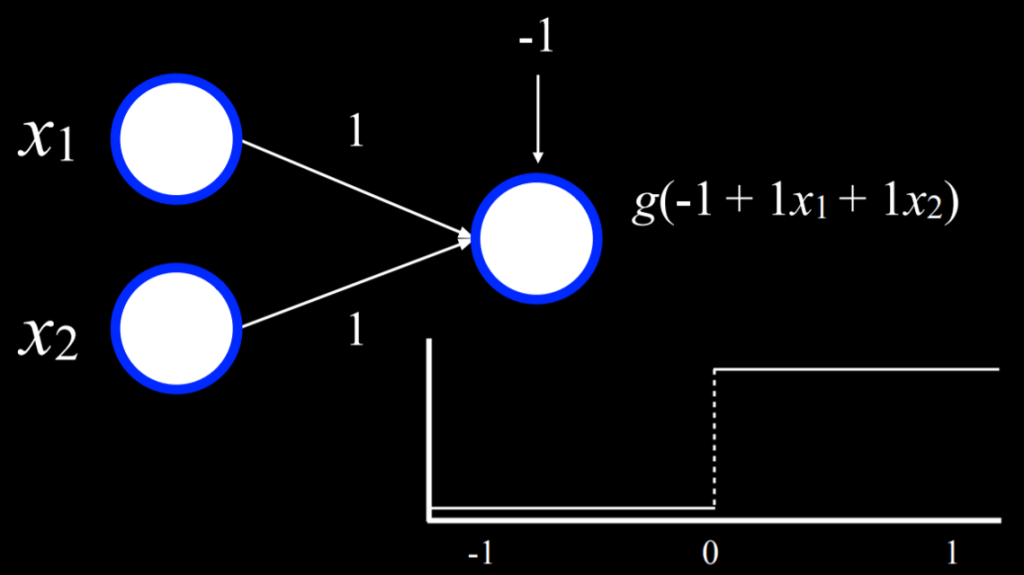
Here, the designated weights for each unit is equal to 1, and the function g outputs true if ≥ 0, and false if < 0. In case you haven’t noticed, this is the neural network equivalent of an “or” statement! Say that, for the inputs, false = 0 and true = 1. If x₁ = 0 and x₂ = 0, g(-1 + 1x₁ + 1x₂) = g(-1), outputting false, as -1 is below the threshold of 0. This intuitively makes sense: if x₁ is false and x₂ is false, the x₁ or x₂ should also be false. Now, imagine that either or both x₁ and x₂ = 1. g(-1 + 1x₁ + 1x₂) = g(0) or g(1), both of which output true, as both 0 and 1 meet the threshhold. Notice that we were able to express all of these scenarios in such a simple neural network operation.
Gradient Descent
Gradient descent serves as an algorithm to minimize loss during the training of neural networks. It essentially works as follows:
It first initiates with a random selection of weights: This step is simply a knowledgeless starting point in terms of appropriate weighting allocation for each input.
It then continuously iterates through the following steps:
- Calculate the gradient by considering all data points that contribute to diminishing the loss
- Adjust the weights in alignment with the calculated gradient
While this process is relatively simple and intuitive, it has a major drawback: to calculate gradients, it uses the entirety of data points, which leads to substantial computational costs. But many strategies exist to mitigate this issue. One approach is the Stochastic Gradient Descent, where gradient is calculated based on randomly chosen data points. Although this type of gradient might lose some accuracy, it is a relatively simple fix to the problem. It is important to note that there is no complete, flawless fix to this problem.
Leveraging gradient descent allows us to solve a multitude of challenges. Consider a scenario where the question is more nuanced than a simple “will it rain today?” By utilizing certain inputs, probabilities can be generated for diverse weather conditions. Subsequently, the most probable weather condition can be selected as the outcome. The diagram below shows the use of gradient descent when answering the question “what will be the weather like today?”:

This approach is applicable across various input-output configurations, where each input establishes connections with every output. These outputs correspond to actionable decisions. It’s essential to recognize that, in such neural networks, the outputs remain unconnected. Consequently, each output, along with its respective weights stemming from all inputs, can be regarded as an independent neural network. This independence permits separate training of each output in isolation from the others.
Extension: Multilayer Neural Networks
A multilayer neural network, also known as an artificial neural network, consists of an input layer, an output layer, and at least one hidden layer. When training the model, we specify inputs and desired outputs, but we do not directly provide values to the neurons within the hidden layers. In the first hidden layer, each neuron receives weighted values from every neuron in the input layer, processes them, and generates an output. These output values are then weighted and passed to the next layer, continuing this process until the output layer is reached. This sequential propagation through hidden layers enables the network to capture and represent complex, non-linear relationships within the data. Essentially, it is composed of multiple single-layer Neural Networks, as can be seen in the diagram below:

Backpropagation
Backpropogation is an algorithm used to training multilayer neural networks. It does the following:
- Calculate error value for output layer
- For each layer that is one-back:
- Update weights
- Repeat from error calculations from step 1
Applying the Backpropagation algorithm multiple times will eventually train the neural network.
Precautions: Overfitting
Overfitting poses a risk when the model closely mirrors the characteristics of the training data, making it less effective at generalizing to unseen data. One approach to address overfitting is through a technique known as dropout. During the learning phase, dropout involves the temporary removal of randomly selected units within the network. This strategy aims to discourage an excessive reliance on any particular unit within the network. Throughout the training process, the neural network takes on various configurations, periodically excluding different units and then reintegrating them into the model. This can be seen in the following four diagrams, where random units have been dropped:

Recurrent Neural Networks
The neural networks we’ve explored thus far fall under the category of Feed-Forward Neural Networks (FFNNs). In FFNNs, input data is fed into the network, leading to the generation of an output. Below, you can find an illustration depicting the operation of feed-forward neural networks:

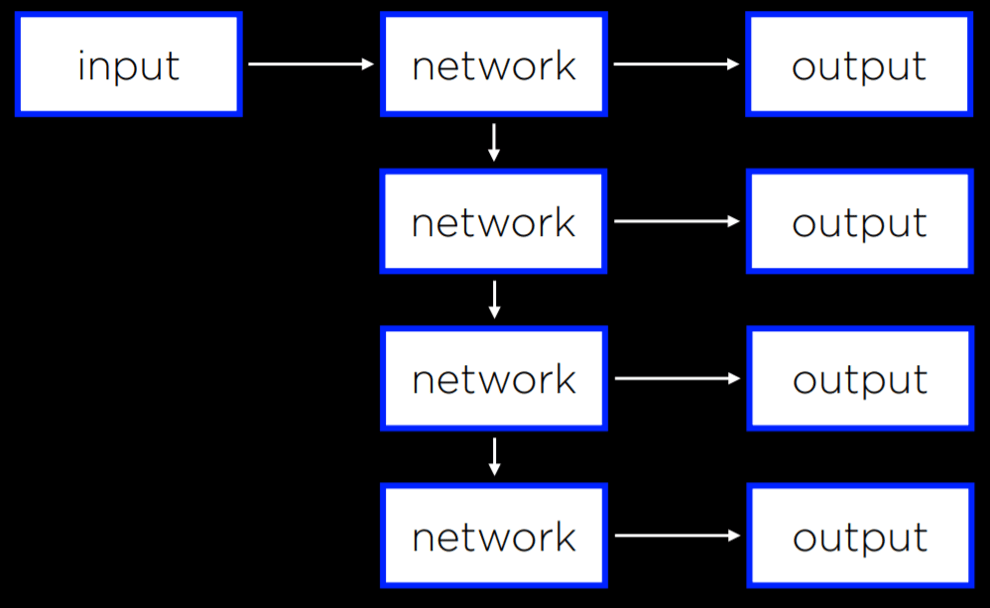
In contrast, Recurrent Neural Networks (RNNs) have a distinctive non-linear architecture, allowing them to utilize their own outputs as inputs. While feed-forward neural networks are limited in their ability to vary the number of outputs, recurrent neural networks can adapt to this problem due to their inherent structure. In the context of captioning, an RNN would process the input, generate an output, and then continue processing from that point onward, producing subsequent outputs as needed. Below is an illustration depicting the operation of recurrent neural networks:
 Hardwired Eloquence